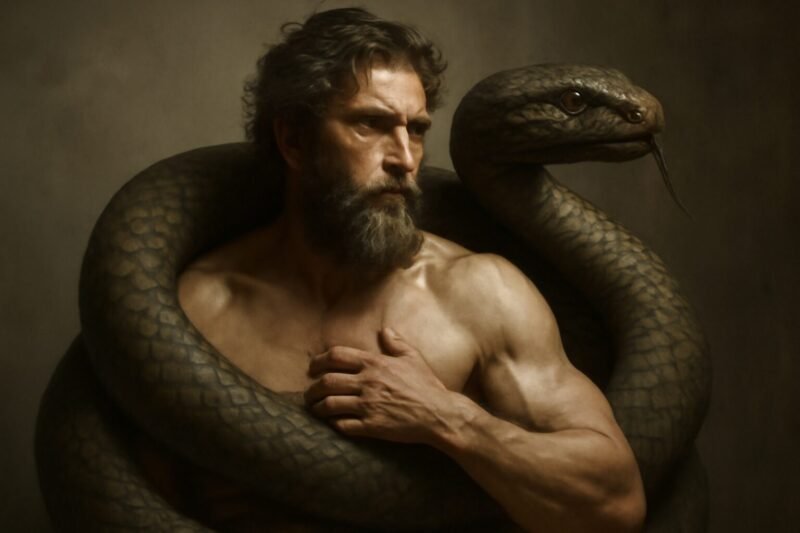
Ophion: The Forgotten Serpent of Greek Mythology
In the vast pantheon of Greek mythology, Ophion is a lesser-known but fascinating figure—a primordial serpent deity associated with creation and the earliest days of the cosmos. His name, derived from the Greek word ophis (meaning "serpent"), hints at his serpentine form and his connection to the earth and chaos.
The Primordial Ruler
According to some ancient sources, including the poet Pherecydes of Syros, Ophion and his consort Eurynome ruled the universe before the Titans. They emerged from Chaos and created the cosmic egg, from which all life sprang. Ophion coiled around this egg, symbolizing the protective and generative forces of nature. However, his reign was short-lived—he was overthrown by the Titans Cronus and Rhea, who cast him into the depths of the ocean or Tartarus.
Powers and Symbolism
As a primordial serpent, Ophion embodied the untamed, chaotic forces of creation. Unlike later Olympian gods, he represented the raw, unshaped power of the universe before order was imposed. His serpentine form linked him to themes of rebirth, wisdom, and the cyclical nature of existence—echoes of which appear in later myths like the Ouroboros, the serpent devouring its own tail.
Relationships and Legacy
Ophion’s myth intersects with other creation stories, particularly those involving Gaia (Earth) and Uranus (Sky). Some scholars suggest his tale reflects an older, pre-Olympian tradition where serpent deities held greater prominence. His defeat by the Titans mirrors later conflicts, such as Zeus’s overthrow of Cronus, reinforcing the recurring theme of divine succession in Greek mythology.
Though Ophion faded from prominence as the Olympian gods rose, his influence lingered in esoteric traditions and Orphic cosmogonies, where serpents remained symbols of hidden knowledge and primal power.
Significance in Myth
Ophion’s story highlights the Greeks’ fascination with origins and the struggle between chaos and order. While not as widely worshiped as Zeus or Apollo, his myth offers a glimpse into the earliest layers of Greek religious thought, where the universe was shaped by monstrous, elemental beings before the gods of Olympus took control.
Alternative Names for Ophion
God Name: Ophioneus (Greek)
An alternative name for Ophion, used in some ancient Greek texts to emphasize his serpentine nature.
God Name: Ophion the Elder (Greek)
A title distinguishing him from later serpent deities, highlighting his primordial role in some cosmogonies.
God Name: Protogonos Ophion (Orphic Tradition)
In Orphic traditions, Ophion is sometimes referred to as Protogonos (First-Born), linking him to creation myths.
God Name: Anguis (Roman Syncretism)
Though not a direct equivalent, some Roman sources loosely associate Ophion with Anguis (serpent deities), blending his traits with local serpentine figures.
Tales about Ophion
Ophion and Eurynome: The First Rulers of Olympus
In the primordial age, before the reign of the Titans, Ophion and Eurynome emerged from the chaos of creation. They were the first divine couple to claim sovereignty over the cosmos. Ophion, the great serpent of wisdom, coiled around the newly formed world, while Eurynome danced upon the waves, bringing order and beauty. Together, they ruled from the heights of Olympus, their harmony a testament to the balance of primal forces.
However, their reign was not to last. The ambitious Titan Cronus, aided by his mother Gaia, challenged their authority. In a fierce battle, Ophion and Eurynome were cast down from their throne. Some say Ophion was banished to the dark depths of Tartarus, while Eurynome retreated to the ocean, her dance now a mournful rhythm in the tides. This tale marks the transition from the age of primal serpents to the era of the Titans.
Ophion and Chronos: The Serpent and Time
Another legend speaks of Ophion's encounter with Chronos, the primordial embodiment of time. As the universe unfolded, Chronos measured the ages with inexorable precision, while Ophion, representing the cyclical nature of existence, sought to intertwine with time itself. Their meeting was a cosmic event: Ophion’s coils encircled the flow of time, attempting to bind its linear progress into an eternal cycle.
Chronos, unwavering, resisted Ophion’s embrace. The struggle between linear time and cyclical renewal created ripples through reality, giving birth to concepts like fate and destiny. Though Ophion could not fully subdue Chronos, their interaction infused the cosmos with the idea of seasons, epochs, and the promise of rebirth—a legacy that echoes in the myths of Persephone and the turning of the year.
Frequently Asked Questions
Who is Ophion in Greek mythology?
Ophion is a lesser-known Titan in Greek mythology, often depicted as a serpent or dragon who ruled the world before being overthrown by Cronus and the other Titans. Some myths suggest he was the original ruler of the cosmos.
Why are the Titans important in Greek mythology?
The Titans were the first gods in Greek mythology, ruling before the Olympians. They represent primal forces of nature and the universe, and their stories explain the origins of the world and the rise of Zeus and the Olympian gods.
What can we learn from the story of Ophion and the Titans?
The story of Ophion and the Titans teaches about cycles of power, rebellion, and the inevitable change of rulers in mythology. It reflects ancient Greek beliefs about order emerging from chaos and the transfer of divine authority.
How does the concept of Titans apply to modern culture?
The term 'Titan' is still used today to describe someone or something of enormous size, strength, or importance. The stories of the Titans also influence modern literature, movies, and games about gods and mythology.
Was Ophion good or evil in Greek myths?
Ophion wasn't clearly defined as good or evil in Greek mythology. Like many Titans, he represented primordial forces rather than moral concepts. His overthrow was part of the natural cycle of power shifts in Greek cosmogony.