Hekaerge: The Forgotten Goddess of the Hunt
In the vast pantheon of Greek mythology, Hekaerge stands as one of the lesser-known but fascinating deities. Her name, meaning "far-shooting" or "far-worker," hints at her connection to hunting and precision. Though overshadowed by the more famous Artemis, Hekaerge played a unique role in the myths and rituals of ancient Greece.
Origins and Role
Hekaerge was one of the Hyperborean maidens, a group of divine huntresses associated with the mythical northern land of Hyperborea. Alongside her sisters Loxo and Opis, she served as a companion to Artemis, the goddess of the hunt. Together, they embodied the untamed wilderness and the skill required to navigate it.
Unlike Artemis, who was widely worshiped, Hekaerge's presence was more obscure, often appearing in regional cults or as part of Artemis' retinue. Her name suggests she was particularly revered for her ability to strike targets from great distances, a skill highly valued by hunters and warriors.
Powers and Symbolism
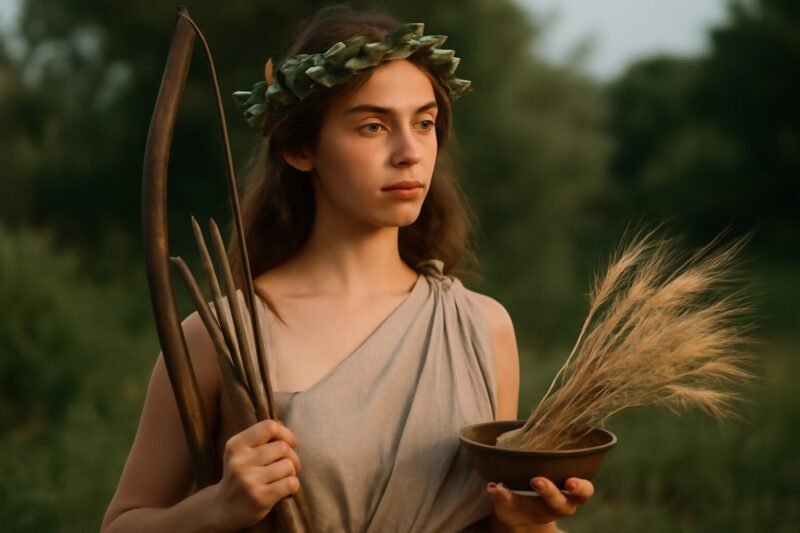
As a huntress, Hekaerge possessed the same keen senses and agility as Artemis. She was often depicted with a bow and arrows, symbols of her precision and deadly aim. Some myths suggest she had the power to control the winds, aiding hunters by guiding their arrows true.
Her connection to Hyperborea, a land of eternal spring and divine favor, also linked her to themes of purity and immortality. Offerings to Hekaerge were believed to bring success in hunting and protection from harm in the wild.
Relationships and Worship
Hekaerge's closest ties were with Artemis and Apollo. As part of Artemis' entourage, she participated in sacred hunts and rituals. Some traditions claim she and her sisters were sent by Apollo to Delos, where they established rites in his honor.
Though no major temples were dedicated to Hekaerge, she was venerated in local cults, particularly in regions where hunting was vital for survival. Her name appears in hymns and inscriptions, often alongside Artemis or Apollo, reflecting her role as a supporting but respected figure in Greek religion.
Legacy and Significance
While Hekaerge never achieved the fame of Olympian gods, her presence in myth highlights the diversity of Greek divine figures. She represents the unsung forces of nature—those spirits and minor deities who governed specific skills and domains.
Today, Hekaerge serves as a reminder of the rich tapestry of Greek mythology, where even lesser-known gods and goddesses played crucial roles in the spiritual and cultural life of the ancient world.
Alternative Names for Hekaerge
God Name: Hekate (Greek)
Hekate is sometimes conflated or associated with Hekaerge in certain Greek traditions, particularly in Orphic and later Hellenistic contexts, where Hekate's role as a goddess of magic and crossroads may overlap with Hekaerge's attributes.
God Name: Trivia (Roman)
In Roman mythology, Trivia is the equivalent of Hekate, and by extension, may be associated with Hekaerge. Trivia, meaning 'three ways,' reflects the goddess's connection to crossroads, similar to Hekate's and possibly Hekaerge's domains.
God Name: Apollo Hekaergos (Greek)
In some interpretations, Hekaerge is considered an epithet of Apollo, particularly in his role as a distant archer or hunter. 'Hekaergos' translates to 'far-working' or 'far-darting,' highlighting Apollo's connection to archery and distant influence.
Tales about Hekaerge
The Huntress and the Healer
In the deep forests of Arcadia, Hekaerge once pursued a magnificent stag, her arrows never missing their mark. But this creature was no ordinary beast—it was blessed by Aceso, goddess of healing. As Hekaerge drew her bow, Aceso appeared, her presence calming the woods.
A Divine Intervention
"Why hunt what is meant to heal?" Aceso asked, her voice like a gentle stream. Hekaerge lowered her bow, intrigued. Aceso explained that the stag carried herbs that could cure plagues. Together, they tracked it not to kill, but to gather its healing moss. From that day, hunters left offerings to both goddesses when seeking game that nurtured rather than harmed. Their alliance was later blessed by Eirene, goddess of peace, who ensured their cooperation brought harmony to the wilds. The sacred moss was placed under the protection of Epimeliades, nymphs of apple trees and guardians of flocks, while Eusebeia, spirit of piety, ensured the hunters' offerings were made with proper reverence.
Winds of Change
When a fierce storm threatened the shores of Thessaly, Hekaerge sought the aid of Aeolus, master of the winds. She found him restraining tempests within his mountain cavern, his brow furrowed with effort.
An Unlikely Alliance
"The gales disrupt the sacred hunts and ravage the woodlands," Hekaerge declared. Aeolus, impressed by her courage, agreed to tame the winds—but only if she guided them with her precision. Using her unerring aim, Hekaerge shot arrows tipped with feathers into the sky, directing each gust where it was needed. The storm subsided, and the two became allies, balancing nature's fury with grace. Their success attracted the attention of Taygete, one of the Pleiades associated with the constellation Orion's hunt, who added stellar guidance to their efforts. Eupraxia, spirit of good conduct, ensured their methods remained honorable, while Orthosie, goddess of prosperity, blessed the lands they protected with abundant game.
Frequently Asked Questions
Who are the Hekaerge in Greek mythology?
The Hekaerge were rustic deities or spirits in Greek mythology, often associated with the wilderness, hunting, and the untamed aspects of nature. They were considered minor gods or nymphs who personified the wild and untamed forces of the natural world.
What does the name 'Hekaerge' mean?
The name 'Hekaerge' is derived from the Greek words meaning 'far-working' or 'far-darting,' which reflects their connection to hunting and the expansive, untamed wilderness. It highlights their role as deities who operated in remote, wild places.
Why are rustic deities like the Hekaerge important in Greek mythology?
Rustic deities like the Hekaerge were important because they represented the Greeks' respect and reverence for nature's untamed aspects. They served as a bridge between humanity and the wild, reminding people of the power and mystery of the natural world.
How do the Hekaerge compare to other Greek gods and goddesses?
Unlike the major Olympian gods who ruled over cities and human affairs, the Hekaerge were minor deities focused on the wilderness. They were more akin to nymphs or spirits, embodying specific natural elements rather than grand cosmic or societal roles.
Are there any myths or stories featuring the Hekaerge?
The Hekaerge are not as prominently featured in myths as major gods, but they occasionally appear in tales involving Artemis, the goddess of the hunt, as her companions or attendants. Their stories often emphasize their connection to wild places and hunting.