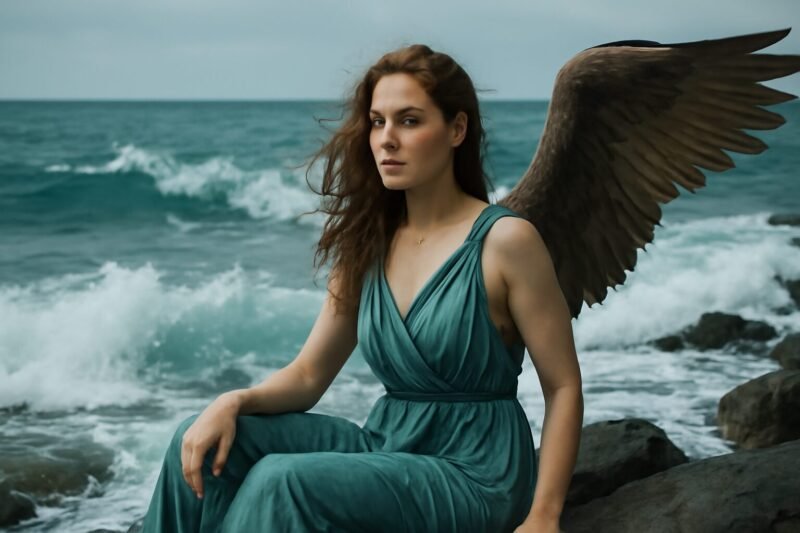
Podarge: The Swift Harpy of Greek Mythology
In Greek mythology, Podarge (meaning "swift-footed") was one of the Harpies, winged spirits known for their speed and ferocity. Often depicted as half-woman, half-bird creatures, the Harpies were agents of punishment, snatching away people or things with terrifying efficiency. Podarge, whose name reflects her incredible speed, played a unique role in myth, particularly in relation to the divine horses of the gods.
Mythology and Powers
Podarge was most famously known as the mother of Balius and Xanthus, the immortal horses of the hero Achilles. According to legend, she conceived these magnificent steeds after mating with Zephyrus, the West Wind. This union symbolized the blending of swiftness (Podarge) and the power of the wind (Zephyrus), resulting in horses of unmatched speed and endurance.
As a Harpy, Podarge possessed the ability to fly at incredible speeds, making her nearly impossible to catch. Harpies like her were often sent by the gods to torment mortals, stealing food or carrying off individuals as punishment. Their presence was feared, as they embodied the merciless and unpredictable forces of nature.
Relationships and Significance
Podarge's connection to Zephyrus highlights the interplay between different mythological beings—monstrous spirits like the Harpies and the more benevolent wind gods. Her offspring, Balius and Xanthus, were no ordinary horses; they were divine creatures gifted to Achilles by Poseidon, capable of understanding human speech and prophesying their master's fate.
Though Harpies like Podarge were often seen as terrifying figures, her role as a mother to such revered horses adds complexity to her character. She bridges the gap between the monstrous and the divine, showing that even feared beings could have a place in the grand tapestry of Greek myth.
Podarge's legacy endures as a symbol of swiftness and the untamed forces of nature, reminding us of the Greeks' fascination with the intersection of the human, divine, and monstrous worlds.
Alternative Names for Podarge
God Name: Aello (Greek)
Aello is one of the Harpies, sisters of Podarge, often associated with storm winds and swiftness. The name means 'storm swift' in Greek.
God Name: Ocypete (Greek)
Ocypete is another Harpy sister of Podarge, whose name means 'swift wing' in Greek, emphasizing her speed and role as a wind spirit.
God Name: Celaeno (Roman)
In Roman mythology, Celaeno is one of the Harpies, sometimes identified with Podarge or her sisters. The name means 'the dark one,' referring to storm clouds.
God Name: Harpyia (Greek)
Harpyia is a collective term for the Harpies, including Podarge, often used in Greek texts to describe their role as snatchers or whirlwind spirits.
Tales about Podarge
Podarge and Zephyrus: The Swift-Winged Union
In the wild, untamed skies where the winds dance and clash, Zephyrus, the gentle west wind, often found himself drawn to the fierce grace of Podarge, one of the swiftest of the Harpies. Known for her fleetness and stormy temperament, Podarge was a creature of both sea and sky, her wings cutting through the air with the speed of a gale. Zephyrus, whose breath brought spring and renewal, saw not just the tempest in her but the life that thrived within it.
A Dance of Wind and Wing
One twilight, as Zephyrus swept across the horizon, he spotted Podarge racing the clouds over the Aegean Sea. Intrigued by her unmatched speed, he challenged her to a race, promising that if she could outpace him, he would grant her a boon. Podarge, never one to refuse a contest, surged forward, her wings a blur. But Zephyrus, with his effortless grace, matched her turn for turn, not to defeat her, but to dance alongside her in the vast expanse.
Impressed by her spirit and strength, Zephyrus revealed his true intent: he wished not to conquer, but to court her. Moved by his sincerity and the warmth of his winds, Podarge accepted his companionship. From their union came the immortal, swift-footed horses Xanthus and Balius, who would later serve the great hero Achilles, embodying their mother's speed and their father's enduring strength.
Podarge and Aello: Sisters of the Storm
Among the Harpies, Podarge and her sister Aello were renowned as the fiercest and fastest, their names meaning "Swift-Foot" and "Storm-Wind" respectively. They were daughters of the sea god Thaumas and the Oceanid Electra, and their bond was as tempestuous as the gales they commanded.
The Quest for the Golden Fleece
When the Argonauts embarked on their quest for the Golden Fleece, they encountered the Harpies sent by Zeus to torment the blind prophet Phineus. Podarge and Aello led the assault, swooping down to snatch the food from Phineus's table, leaving him in perpetual hunger. Their speed was such that no mortal could catch them, and their cries echoed like storms.
It was the winged sons of Boreas, Zetes and Calaïs, who took up the challenge to drive the Harpies away. In a breathtaking aerial battle, Podarge and Aello clashed with the Boreads, their fierce winds meeting the brothers' icy gusts. Though eventually forced to retreat, the Harpies were spared at the request of Iris, promising to cease their torment. Podarge and Aello returned to their stormy realms, their legend forever tied to the epic of Jason and the Argonauts, a testament to their power and sisterly unity in the face of adversity.
Frequently Asked Questions
Who is Podarge in Greek mythology?
Podarge is one of the Harpies, winged spirits in Greek mythology known for snatching things or people. She is associated with the sea and storms, often depicted as a swift wind spirit.
What does the name Podarge mean?
The name Podarge translates to 'swift-footed' or 'fleet-footed' in Greek, reflecting her role as a fast-moving wind spirit and her connection to storms and the sea.
Why are the Harpies like Podarge important in Greek myths?
Harpies like Podarge serve as agents of punishment or messengers of the gods, often carrying out divine retribution. They symbolize the unpredictable and destructive forces of nature, particularly storms at sea.
How does Podarge relate to other sea deities?
Podarge is connected to other sea deities through her role as a wind spirit. She interacts with gods like Poseidon, who controls the seas, and other storm-related figures, embodying the chaotic aspects of the ocean.
What can we learn from the myth of Podarge today?
Podarge's myth reminds us of humanity's historical attempts to explain natural phenomena like storms through storytelling. It also highlights how ancient cultures personified nature's power and unpredictability.