Phonoi: The Greek Spirits of Murder
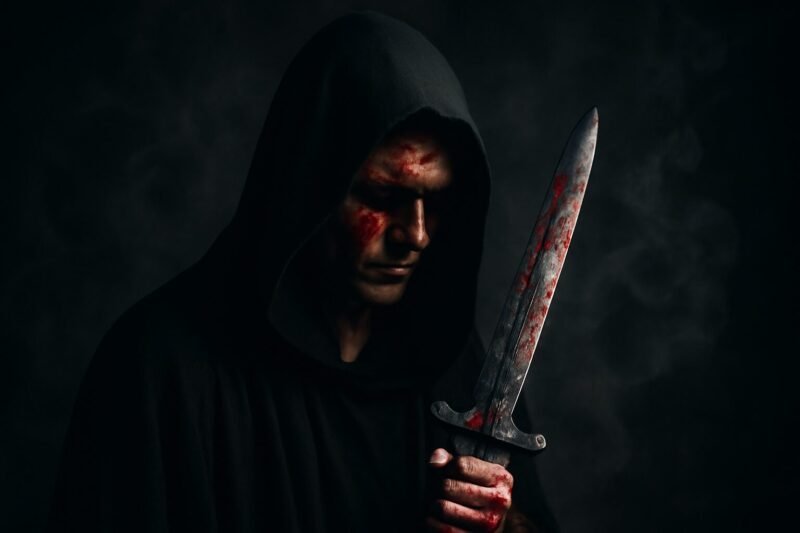
In Greek mythology, Phonoi (singular: Phonos) were the malevolent spirits or personifications of murder, slaughter, and violent death. Born from the blood of the primordial deity Ouranos (the sky) when he was castrated by his son Cronus, the Phonoi were among the many dark forces unleashed upon the world. They were closely associated with other destructive spirits, such as the Keres (death spirits) and Eris (strife).
Role and Powers
The Phonoi were not individual gods but rather a collective force embodying the act of killing. They were invisible, relentless, and often worked alongside Ares, the god of war, to incite bloodshed on battlefields. Unlike Ares, who represented the chaotic fury of war, the Phonoi were more focused on the act of murder itself—whether in battle, through treachery, or in cold blood.
Their presence was feared because they could drive mortals (and even gods) to commit violent acts beyond reason. Some myths suggest they whispered in the ears of warriors, filling them with bloodlust, or stalked those destined to die by violence.
Relationships and Myths
The Phonoi were siblings to other dark entities, including the Erinyes (Furies), who punished oath-breakers and kin-slayers, and the Oneiroi (spirits of dreams), who brought nightmares. Their origins tied them to the earliest forces of the cosmos, making them ancient and inescapable aspects of human suffering.
Though they rarely appeared in major myths as named figures, their influence was felt in stories of war and vengeance. For example, in the Iliad, the relentless slaughter of the Trojan War could be seen as the work of the Phonoi, driving warriors like Achilles into uncontrollable rage.
Significance in Greek Mythology
The Phonoi represented the darker side of existence—forces that could not be reasoned with or appeased. Unlike gods who could be worshiped for favor, the Phonoi were simply there, an ever-present threat in a world where violence was commonplace. They served as a reminder of humanity's capacity for destruction and the inevitability of bloodshed in both war and betrayal.
Their legacy endures in modern interpretations of Greek mythology, often symbolizing the inescapable nature of violence and the psychological toll of murder. While lesser-known than gods like Zeus or Hades, the Phonoi were a chilling embodiment of the ancient Greeks' understanding of death’s darker forms.
Alternative Names for Phonoi
God Name: Phonoi (Greek)
The primary Greek name for the god of murder and slaughter, representing the personification of killing.
God Name: Letum (Roman)
The Roman equivalent of Phonoi, associated with death and destruction, though not as widely attested in mythology.
God Name: Androktasiai (Greek)
An alternative Greek name referring to the spirits or personifications of battlefield slaughter, closely related to Phonoi in function.
God Name: Makhai (Greek)
Another Greek term for the spirits of battle and combat, sometimes associated with Phonoi as deities of violent conflict.
Tales about Phonoi
The Wrath of Ares and the Birth of Phonoi
In the heat of battle during the Trojan War, Ares, the god of war, found his fury unmatched. As blood soaked the fields of Troy, his rage gave form to a new terror: the Phonoi, spirits of slaughter and murder. These entities, born from the very essence of conflict, swept through the ranks, turning honorable combat into brutal carnage. They whispered into the ears of warriors, fueling paranoia and betrayal, ensuring that no blow was struck without malice.
Whispers of Destruction
Wherever Ares trod, the Phonoi followed, relishing in the chaos. They were not mere spectators but active agents of demise, relishing every scream and every life extinguished in violence. Their presence made battles more horrific, as they embodied the darkest aspects of war that even Ares sometimes hesitated to acknowledge.
Phonoi and the Curse of Atë
In a tale of divine folly, Atë, the spirit of delusion and ruin, once tricked the gods into a series of reckless oaths. As punishment, Zeus banished her from Olympus, casting her down to wander among mortals. Wherever she went, misfortune followed, and it was there that she crossed paths with the Phonoi.
A Partnership of Ruin
Atë's talent for clouding minds paired perfectly with the Phonoi's hunger for violence. Together, they incited families to turn on one another, friends to become foes, and kingdoms to tear themselves apart from within. This alliance showed that murder often begins not with a weapon, but with a poisoned thought, making their combined influence deadlier than any war.
Frequently Asked Questions
What are Phonoi in Greek mythology?
Phonoi are the personifications of murder, killing, and slaughter in Greek mythology. They are considered daimones (spirits) who embody the violent aspects of human nature and warfare.
Why are personifications like Phonoi important in Greek myths?
Personifications like Phonoi help explain abstract concepts, such as violence or death, by giving them a tangible form. They make these ideas easier to understand and connect to human experiences and emotions.
What can we learn from the concept of daimones like Phonoi?
Daimones like Phonoi teach us about how ancient Greeks viewed the forces of nature and human behavior. They reflect the belief that even destructive actions had spiritual or divine origins.
How do Phonoi and similar spirits apply to modern life?
While we no longer personify concepts like murder as spirits, understanding Phonoi reminds us of humanity's long-standing struggle with violence and the ways cultures have sought to explain it.
Are Phonoi considered gods or minor spirits in Greek mythology?
Phonoi are considered minor spirits (daimones) rather than major gods. They represent specific aspects of life and are often less prominent than the Olympian gods in myths.