Idaios: The Lesser-Known Herald of the Gods
In the vast pantheon of Greek mythology, Idaios stands as a lesser-known but intriguing figure. His name, meaning "of Mount Ida," connects him to two sacred mountains—one in Crete and another in the Troad region of Anatolia. While not as prominent as Hermes, the primary messenger god, Idaios served as a herald and intermediary in specific mythological contexts.
Roles and Significance
Idaios appears primarily in the Iliad, where he serves as a herald for King Priam of Troy during the Trojan War. His most notable moment comes when he accompanies Priam on the dangerous journey to retrieve Hector's body from Achilles. This act highlights Idaios' role as a trusted envoy, demonstrating courage and diplomacy in the face of mortal peril.
In some traditions, Idaios is also associated with the Dactyls, mysterious beings connected to Mount Ida in Crete who were said to have discovered iron and copper working. This links him to early metallurgy and the magical arts.
Mythological Connections
Idaios' parentage varies in different sources. Some accounts name him as the son of Dares, a priest of Hephaestus in Troy, while others connect him to the Cretan Mount Ida and its mythological traditions. His dual associations with both major mountains named Ida create an interesting geographical connection in Greek mythology.
As a herald figure, Idaios shares some characteristics with Iris and Hermes, though with much more limited scope and power. His appearance in the Iliad provides a human counterpoint to the divine messengers, showing how mortal heralds played crucial roles in diplomacy and communication during wartime.
Cultural Importance
While not worshiped as a major deity, Idaios represents the importance of heralds in ancient Greek society. Heralds were protected by sacred laws, and their role in maintaining communication between warring parties was considered divinely sanctioned. Idaios' successful mission with Priam underscores this cultural value.
The figure of Idaios also reflects the Greek tendency to personify geographical features and local traditions. His connection to Mount Ida—whether the Cretan or Trojan version—shows how places could give rise to mythological figures who embodied their significance.
Alternative Names for Idaios
God Name: Idaeus (Greek)
An alternative spelling or Latinized form of Idaios, often used in Roman contexts or later Greek literature.
God Name: Idaeus (Roman)
The Roman adaptation of the Greek name Idaios, maintaining the same meaning and associations, often used in Roman texts referencing the god.
God Name: Idaian (Greek)
A poetic or epithet form derived from Mount Ida, linking the god to this sacred location, often found in hymns or epic poetry.
God Name: Kouros of Ida (Greek)
A descriptive title emphasizing the god's youthful aspect (Kouros) and his connection to Mount Ida, used in cultic or mythological contexts.
Tales about Idaios
Idaios and the Healing of the Mountain
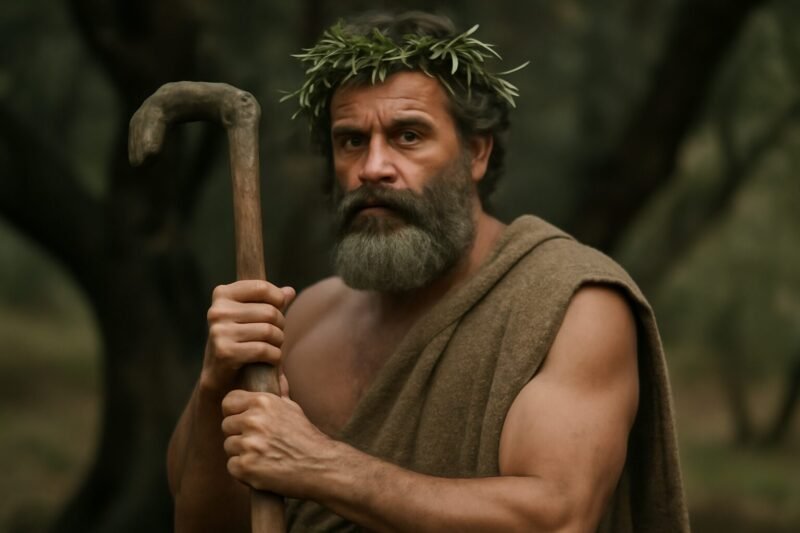
Deep in the wooded slopes of Mount Ida, the rustic deity Idaios tended to the sacred groves, his presence a balm to the ancient trees and hidden springs. One summer, a strange malaise fell upon the mountain—flowers wilted, streams ran sluggish, and the very air grew heavy with sickness. Idaios, concerned for his domain, journeyed to the highest peak where the mists whispered of divine aid.
There, he encountered Iaso, daughter of Asclepius, whose gentle hands glowed with the light of recuperation. "Great Iaso," Idaios implored, "the mountain suffers. Can your art restore its vitality?"
Iaso smiled, her compassion as clear as a mountain spring. Together, they traversed the slopes, Iaso anointing the soil with healing herbs while Idaios channeled the mountain’s innate strength. Wherever they passed, blossoms burst forth, waters ran clear, and the wildlife regained its vigor. Their collaboration became a legend among the nymphs, a testament to the power of nature and nurture intertwined.
Idaios and the Guardian of the Wilds
In the heart of Crete, where the Idaean Cave harbored secrets of old, Idaios stood watch as a sentinel of the wilderness. One moonless night, a shadow fell over the land—a blight that twisted the vines and silenced the creatures. Idaios sensed a presence of corruption, one that threatened the balance he cherished.
Determined to confront this menace, he ventured into the deepest thicket, where he found the source: a manifestation of decay, feeding on the life force of the forest. As Idaios raised his staff to defend his home, a figure emerged from the gloom—Aristaeus, the protector of beekeepers and olive groves, his eyes sharp with purpose.
"This blight is not of nature," Aristaeus declared, his voice steady. "It is a chaos born of neglect. Together, we can purify this land."
Idaios and Aristaeus joined forces, the former drawing strength from the earth, the latter invoking the order of cultivation. With Idaios grounding the corruption and Aristaeus weaving spells of renewal, they cleansed the forest, restoring harmony. From that day, the Idaean woods flourished under their shared vigilance, a symbol of unity between the wild and the cultivated.
Frequently Asked Questions
Who is Idaios in Greek mythology?
Idaios is a rustic deity in Greek mythology, often associated with Mount Ida. He is considered a minor god connected to nature, shepherds, and the wilderness.
Why is Mount Ida important to Idaios?
Mount Ida is significant because it is the sacred mountain linked to Idaios. In Greek mythology, it is often depicted as his dwelling place and a symbol of his connection to rustic and natural elements.
What role did rustic deities like Idaios play in ancient Greek culture?
Rustic deities like Idaios represented the untamed aspects of nature, such as forests, mountains, and rural life. They were important to farmers, shepherds, and those who relied on the land, as they were believed to protect and influence natural forces.
How does Idaios compare to more well-known Greek gods like Zeus or Apollo?
Unlike major gods like Zeus or Apollo, who ruled over broad domains like the sky or the arts, Idaios is a minor deity focused on specific rustic and natural elements. He represents a simpler, more localized aspect of Greek mythology.
Are there any myths or stories featuring Idaios?
Idaios is not prominently featured in major Greek myths, as he is a lesser-known rustic deity. However, he is sometimes mentioned in connection to Mount Ida or as a companion to other nature-related gods and spirits.