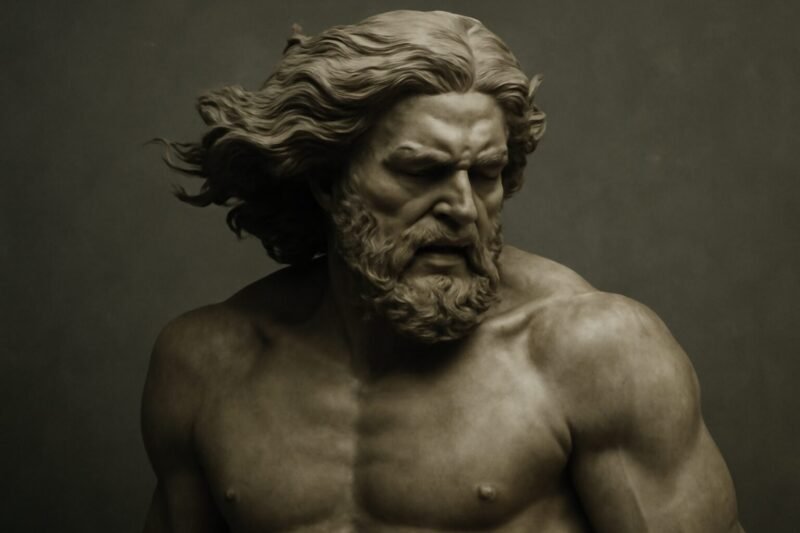
Kydoimos: The Personification of Battle Chaos
In the vast pantheon of Greek mythology, Kydoimos (also spelled Cydoemus) stands out as a lesser-known but fascinating figure. He is the personification of the confusion, uproar, and chaos of battle—an embodiment of the terrifying din that accompanies war. His name translates to "tumult" or "din of battle," reflecting his role in the heat of combat.
Role and Significance
Kydoimos was not a major deity but rather a daimon (spirit) who thrived in the frenzy of war. He was often depicted alongside other war-related spirits, such as Phobos (Fear) and Deimos (Terror), sons of Ares, the god of war. Together, they amplified the psychological terror of battle, ensuring that warriors experienced not just physical danger but also overwhelming mental distress.
Ancient Greeks believed that Kydoimos thrived in the thick of combat, where the clash of weapons, screams of the wounded, and the general disorder created an environment he ruled. His presence was said to disorient soldiers, making them lose their bearings and succumb to panic.
Mythology and Relationships
Kydoimos is mentioned in Hesiod's Theogony, where he is listed among the offspring of Eris (Strife), making him a sibling to other destructive forces like Ponos (Toil), Lethe (Forgetfulness), and Limos (Starvation). This lineage ties him to the darker aspects of human existence, emphasizing his role in amplifying suffering during war.
Though not a central figure in many myths, Kydoimos appears in artistic and literary depictions of battle scenes, often as a shadowy, frenzied figure. He was sometimes invoked in epic poetry to heighten the dramatic tension of war narratives, emphasizing the brutal reality of combat beyond mere strategy and heroism.
Legacy and Symbolism
Kydoimos represents the inescapable chaos of war—a reminder that battle is not just about glory but also about the psychological and sensory overload that accompanies it. Unlike Ares, who embodies the aggressive spirit of war, Kydoimos symbolizes its disorienting, uncontrollable nature.
His influence can be seen in later interpretations of war’s psychological effects, resonating even in modern discussions of combat stress and the fog of war. Though not worshiped like major gods, Kydoimos remains a powerful symbol of the unseen forces that shape human conflict.
Alternative Names for Kydoimos
God Name: Kydoimos (Greek)
The primary Greek name for the god, associated with the din of battle, confusion, and the tumult of war.
God Name: Confusio (Roman)
A Roman equivalent or interpretation of Kydoimos, representing chaos and confusion in battle, though less commonly attested in primary sources.
God Name: Kydoimos (u039au03c5u03b4u03bfu03b9u03bcu03ccu03c2) (Greek)
An alternative Greek spelling or transliteration of the name, emphasizing its original form in Greek script.
Tales about Kydoimos
The Tumult of War and the Whisper of Healing
In the midst of a brutal clash between mortal armies, Kydoimos reveled in the chaos. The air was thick with the cries of the wounded and the clang of swords, a symphony to his ears. But as the battle raged, a gentle presence emerged—Aceso, the goddess of healing. She moved through the turmoil, her touch bringing solace to the injured. Kydoimos, intrigued by this contrast to his nature, watched as Aceso’s calm demeanor began to still the frenzy. Though he thrived on conflict, he found a strange respect for her power to mend what he broke, a silent acknowledgment between chaos and cure.
The Roar of Conflict and the River’s Rage
Along the banks of a mighty river, Kydoimos incited a skirmish between two tribes, stirring hatred and violence. The noise of battle echoed over the waters, catching the attention of Achelous, the river god. Enraged by the disruption to his peaceful domain, Achelous summoned a torrential flood, sweeping warriors aside and drowning their shouts. Kydoimos, instead of retreating, danced upon the waves, his chaotic spirit merging with the river’s fury. Together, they created a tempest of conflict and nature’s wrath, a fleeting alliance where tumult met torrent in a display of raw, untamed power.
Frequently Asked Questions
Who is Kydoimos in Greek mythology?
Kydoimos is the personification of the din and confusion of battle in Greek mythology. He is one of the lesser-known daimones (spirits) who represents the chaotic noise and tumult of war.
What does Kydoimos symbolize?
Kydoimos symbolizes the chaos, noise, and disorder that accompany battles. He embodies the terrifying sounds of clashing weapons, war cries, and the general mayhem of combat.
Why is Kydoimos important in Greek mythology?
Kydoimos is important because he represents an aspect of war often overlookedu2014the psychological and sensory overwhelm of battle. He highlights how ancient Greeks personified even abstract concepts like noise and confusion.
How does Kydoimos relate to modern understanding of war?
Kydoimos' representation of battle chaos can be compared to modern discussions about the psychological impact of war, such as the stress and sensory overload soldiers experience in combat zones.
Are there any myths or stories featuring Kydoimos?
Kydoimos is rarely featured in prominent myths but is sometimes mentioned alongside other war-related spirits or deities, like Ares (god of war) or Eris (goddess of strife), to emphasize the chaos of battle.