Lupe: The Enigmatic Figure in Greek Mythology
While Lupe is not one of the most widely recognized figures in Greek mythology, her name carries significant meaning. Derived from the Greek word "λύπη" (lype), meaning "grief" or "sorrow", Lupe personifies the concept of emotional pain and suffering. Unlike the Olympian gods, she is more of an abstract personification, similar to other deities like Nyx (Night) or Thanatos (Death).
Role and Symbolism
In Greek mythology, Lupe represents the inevitable experience of grief that accompanies human life. She is often depicted as a shadowy, mournful figure, embodying the deep sorrow that follows loss, betrayal, or misfortune. Unlike the more active gods and goddesses, Lupe's presence is passive—she is the result of events rather than their cause.
Her role is closely tied to other personifications of suffering, such as Algos (Pain) and Penthos (Mourning). Together, they form a triad of emotional distress, often appearing in myths where mortals endure hardship, such as the tragedies of Niobe or Orpheus.
Mythological Connections
Lupe is rarely the focus of standalone myths but appears in stories where grief plays a central role. For example, she is implicitly present in the tale of Demeter, who experiences profound sorrow after the abduction of her daughter Persephone. Similarly, Lupe's influence is felt in the story of Achilles, who is consumed by grief after the death of Patroclus.
She is also associated with the Furies (Erinyes), who punish those who commit moral crimes, often bringing grief as a consequence of their actions. In this way, Lupe serves as both a natural emotional response and a divine force intertwined with justice and retribution.
Legacy and Cultural Significance
Though Lupe is not as prominent as other deities, her concept resonates deeply in Greek literature and philosophy. The ancient Greeks acknowledged grief as an inescapable part of the human condition, and Lupe's personification reflects their understanding of emotional suffering. Tragedians like Sophocles and Euripides often explored her themes in their plays, emphasizing the cathartic power of sorrow.
Today, Lupe's legacy endures as a symbol of the universality of grief. Her name and essence remind us that sorrow, while painful, is a shared human experience—one that connects us across time and culture.
Alternative Names for Lupe
God Name: Lupa (Roman)
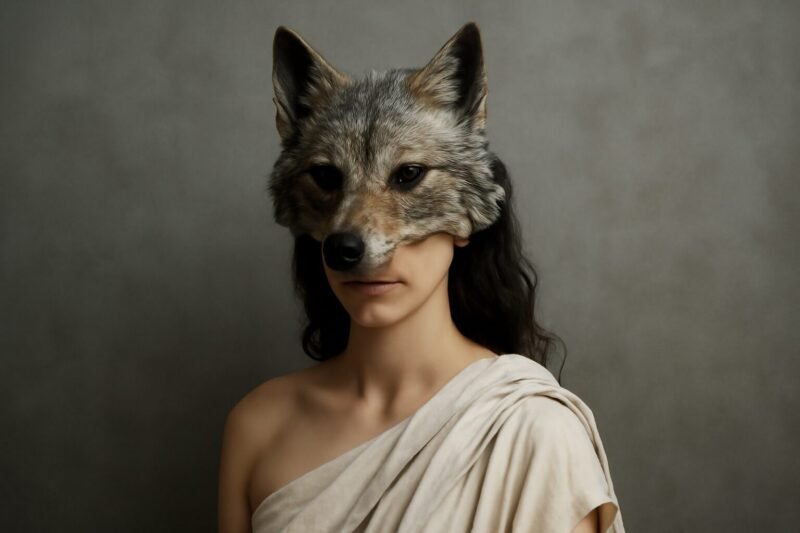
In Roman mythology, Lupa is the she-wolf who nursed Romulus and Remus, the founders of Rome. The name is a direct Latin counterpart to the Greek 'Lupe', both meaning 'wolf'.
God Name: Lykoos (Greek (Epithet))
An epithet meaning 'wolf-like' or 'of the wolf', used in certain Greek contexts to describe deities or figures associated with wolves, potentially including Lupe.
God Name: Lykaios (Greek (Alternative))
Derived from 'lykos' (wolf), this name is associated with Zeus Lykaios, a wolf-form of Zeus in Arcadian mythology. It may be used contextually for wolf-related deities like Lupe.
Tales about Lupe
Lupe and the Healing of Aceso
In a forgotten corner of Ourea, the mountain spirit, lay a village plagued by a sorrow that clung like morning fog. Lupe, the spirit of grief and pain, had settled there, her presence a heavy shroud. The villagers' wounds festered, their hearts ached, and hope seemed a distant memory. They cried out not for an end to their suffering, but for the strength to bear it.
Their lament reached the ears of Aceso, the goddess of the healing process. Unlike her father Asclepius, who cured ailments, Aceso attended to the slow, arduous journey of mending. She descended to the village, not with a brilliant light, but with a gentle, persistent glow.
The Unwinding of Pain
Aceso did not command Lupe to leave. Instead, she sat beside the personification of pain and began her work. She showed Lupe that grief, when witnessed and tended to, could transform. Aceso’s magic was in the careful cleaning of a wound, the patient re-knitting of torn flesh, and the quiet reassurance that pain was a process, not a permanent state.
Lupe, who had only known how to inflict, watched in fascination. She saw that Aceso’s healing was not a battle against her, but a collaboration. The sharp, stabbing pains of fresh loss softened into the dull, manageable ache of memory under Aceso's care. Together, they walked through the village, Aceso mending the body and Lupe learning to let the spirit grieve without breaking.
From that day, Lupe understood that her purpose was not merely to cause suffering, but to signify a hurt that was worthy of healing. She and Aceso became an unlikely pair, one representing the wound and the other the slow, beautiful, and necessary path to its closure.
Lupe's Echo in the Cavern of Pan
Deep within an Arcadian forest, where the music of Pan's pipes usually brought wild joy, a silence had fallen. Lupe had wandered into the sacred grove, her essence dampening the revelry. The satyrs and nymphs felt a profound melancholy, their dances slowing to a halt. Even Pan's melodies turned mournful, echoing the collective sorrow Lupe emanated.
The rustic god, initially annoyed by the intrusion, soon sensed the depth of this grief. It was not a simple sadness but a profound, existential pain. He sought counsel from Echo, the oread who could only repeat the words of others. He found her in a cavern, her own form a testament to a love lost, and she repeated his sigh back to him, amplifying his concern.
The Symphony of Sorrow
Instead of driving Lupe away, Pan made a decision. He sat upon a mossy stone, lifted his pipes, and began to play. But this was not a tune of frenzied celebration. He played the melody of Lupe's pain. The music was haunting, filled with longing and loss, giving form to the formless grief that plagued his domain. As he played, Echo caught the notes and wove them through the cavern, creating a complex, layered symphony of sorrow.
Lupe, who had only been met with resistance, was transfixed. Her pain was being heard, understood, and even beautified. She did not vanish, but her oppressive weight lessened, becoming a part of the forest's emotional tapestry. The nymphs began to move again, not in a joyful skip, but in a slow, graceful dance that honored the pain.
Pan learned that his domain included all passions, not just joy. Lupe found that in this rustic sanctuary, her presence could be acknowledged without being destructive. The forest became a more complete place, where the echo of a sigh was as much a part of its music as the trill of a bird.
Frequently Asked Questions
Who is Lupe in Greek mythology?
Lupe is not a figure in Greek mythology. You might be thinking of 'Lyssa,' the spirit of rage and fury, or another daimones (spirit). Greek mythology has many personifications, so it's easy to get names mixed up.
What are daimones in Greek mythology?
Daimones (or daimons) are minor deities, spirits, or personifications in Greek mythology. They represent abstract concepts, emotions, or natural forces, like Nike (victory) or Thanatos (death). They are less powerful than gods but still influence human life.
Why are personifications important in Greek myths?
Personifications help explain the world by giving human-like forms to emotions, events, or natural phenomena. For example, Eros represents love, making abstract ideas relatable and easier to understand in stories and rituals.
Are Greek spirits (daimones) good or evil?
Daimones can be neutral, good, or harmful, depending on their role. For instance, Eirene (peace) is benevolent, while Moros (doom) brings misfortune. They reflect the duality of life's experiences in Greek belief.
How do Greek personifications apply to modern life?
Concepts like hope (Elpis) or justice (Dike) remain relevant today. These personifications remind us how ancient Greeks framed human experiencesu2014similar to how we use metaphors or symbols to describe emotions and ideas now.